Wednesday, February 20, 2013

Favorite Revision and Editing Tricks


As I've said in other posts, writing as a process is a topic I stress with my students.  Here are my favorite six revision and editing tricks. 

  1.  Use color.  When revising on a printed document (which really should be tip number 7), always use a colorful writing utensil.  If you revisit the same draft more than once, change colors.  Lastly, when you go through your printed draft to copy the changes on to the computer, use a colored pen or marker to cross them off as you go.  When working directly on the computer, use the highlight function to make problem areas stand out for later attention.  Examples include citations you need to look up, notes to yourself about material to add, or anything that sounds off, but you can't fix immediately. 
  2. Read it backwards.  Reading an essay backwards is strictly an editing trick.  Reading the words out of context interrupts your memory of what the text was meant to say.  That allows you to focus on individual words and punctuation marks.  This trick helps find typos, misspellings, capitalization errors, incorrect punctuation, and citation errors. 
  3. Read it out loud to yourself.  An AP teacher in my building used to make all the students circle the room facing the wall.  They then read their papers aloud simultaneously.  Reading aloud forces you to listen to how the words sound rather than just remembering what you meant.  This helps with editing and revision problems involving grammar, punctuation, word choice - all the problems that lead to the vague teacher comment "awkward."
  4. Use find to look for specific errors.  Using the find function in a word processing program can target specific problems.  A student could search for trouble words.  With my dyslexia, I would always search for my common mistakes that formed real words (form / from, who / how).  This is an easy way to check words on the commonly confused list, such as effect / affect or the three there's.  A student can use it to add variety to word choice by searching the over used word and substituting synonyms.  Also, synonyms could be swapped out for vague or weak words.  Lastly, it can be used as a citation checker by searching parenthesis or quotation marks. 
  5. Have someone read it to you.  Ideally, I would ask my students to read their partner's work aloud to them during peer work shopping, but time and volume level requirements often didn't allow it.  Listening to how your writing sounds without reading along can bring those awkward problems to the surface.  Students realize words are left out or in a strange order.  Suddenly, the pronoun references are no longer clear.  Or, maybe the flow between ideas or quotations is now noticeably awkward. 
  6. Distance.  I give my students enough time to work on their writing so that they can put it away for a night or two to get the objectivity time and space offer.  (That is not to say that students budget their time to make use of this opportunity).  Putting a piece of writing away for even just one day offers a fresh light.  The results are very similar to hearing your writing read aloud.  Distance is my favorite trick because it empowers the student to revise and edit independently, and provides the best situation for the student to dive into serious revision.  When someone else is holding the paper, the student can't rip it away to tear a paragraph a part.  

Tuesday, February 12, 2013

Resume / Portfolio Brainstorming


 Resume:
I've done some looking into resumes with unique formatting.  I have a while to decide, but I do think it would be a positive.  I feel like I don't have much to say on a resume.  I only taught for five years and I used that time to discover myself as a teacher, including getting my master's.  I did not do any extra committee work or advising.  Anything to say about my classroom, I feel is redundant.  Superintendents and principals know what it means to teach a full course load, do I really need to itemize it into bullets? 


Portfolio:
I'm a bit jaded about portfolios.  I went through A LOT of work to make one right out of college, and when I was interviewed it wasn't even handed to the interviewer. 

I'm also going back and forth about a traditional binder or digital.  I like the idea of digital quite a bit, especially if it is published for prospective employers to see before interviewing, but I think that it being digital might be hard to deal with during an interview.  I wouldn't be able to just flip to a page and slide it across the table. 

I also think I need to work on making my portfolio items more visual.  I like how my current writing about what I do with Natalie is embedded with pictures.  I don't have that for my teaching experinces. 

I'm strongly considering adding a section for my work with my kids and our mom's group.  It would show what I've been doing while away from teaching, and it would show the direction I want to take for blogging in my classroom for transparency with parents and a reference system for students. 

I'm wondering what to do for a section that represents my education - particularly my master's and the special ed course I just finished.  Also, it could include where I want to go with my education: A second Master's from USM in special education in the program that blends gifted and talented with special education courses.  I also am interested in teaching teachers.  This section might be able to be a document or two rather than artifacts. 

The one traditional piece I know I need is a philosophy statement.  I worry about this though, because I want to be honest, yet I don't want to alienate myself from getting a job. 


I want to give an accurate picture of myself.  What would the items I want to include show as a picture of me?  My blog shows I write myself avidly and wanting to communicate what I do with others (be them parents, absent students, administrators, or other teachers).  Information about what I've been doing recently shows that I haven't been letting my craft get rusty, and my interest in education in general - in life long learning.  I also think that my presented work would show interest in using technology.  But a large part of who I am as an educator is my belief in how I want to run my classroom to best benefit students individual needs.  I am at present fully dedicated to standards based assessment and would prefer to not give traditional scores at all.  I believe in student directed learning in a workshop setting.  I no longer believe in homework, excepting reading and completing writing from class. 

Thursday, February 7, 2013

Rubric-mania!

In the ninth grade, my two humanities teachers introduced our class to rubrics.  I might have understood a little bit at the time, but not fully.  It wasn't until I was using rubrics to grade in my open classroom almost ten years later that I understood rubrics.  And even then, it was still another couple years before I felt comfortable writing my own.  By the time I left teaching to have my first child, I wrote my own rubrics for everything.  In fact, I would have preferred to simply send home a rubric each quarter than a numerical score.

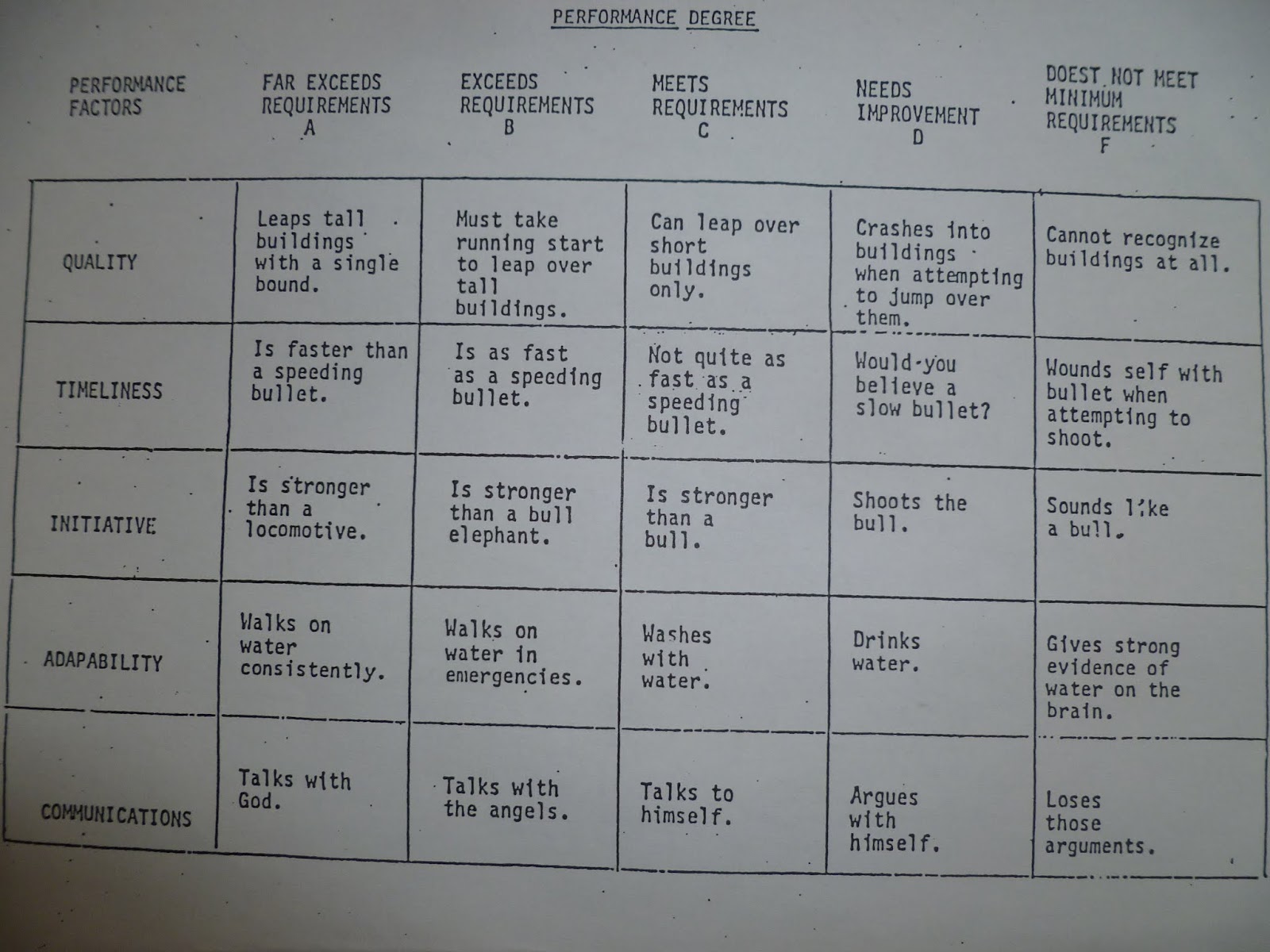
A humorous rubric.  


What is a rubric?
A rubric is an assessment tool.  In actuality, it is a chart with standards typically down the first column and scores across the top row.  The individual boxes contain text that describes student work. 

Why use rubrics?
I love rubrics for a few reasons.
  1. Fairness.  A well written rubric leaves little room for you to accidentally be swayed by your personal knowledge about a student as your grade.  It also covers you from students accusing you of such behavior. 
  2. Easy to use.  Once you are used to them, it is easy to circle the descriptors that match the work and then calculate the score.  
  3. Focus correction areas,  Rubrics help teachers focus on specific skills while grading.  It can be overwhelming to grade a project since there are so many factors at play.  A rubric forces focus on just the areas listed on the rubric.  For me, this is a huge time saver when grading.  
  4. Transparency.  You can give students a rubric right on the day the work is assigned leaving no guesses about how they will be graded.  
  5. Great planning tool.  Writing the rubric as I create the assignment forces me to make sure I keep up my end.  Rubrics help me keep the end result in mind as I plan how to use our class time. 
  6. Self Assessment.  Rubrics provide great opportunity for students to assess themselves.  This could occur at the end of a project when students score themselves.  Yet, even more potent, students can assess their progress frequently along the way to the final assessment. 

How to create a rubric:
First, you must decided what skills or knowledge you are assessing.  As you choose, remember to ask yourself, how will I know the student has meet this standard?  You'll need to have documented evidence. 

EX.  I can't choose appreciation of the writing process.  How will I see that the students appreciate it?  But I can assess use of the writing process to improve writing. 

Next, I start by writing a description of what meets the standard.  Ask yourself, what exactly do I want my students to know or be able to do?

EX.   Student uses revision to improve writing as seen through additions, removals, substitutions, and / or reorganizing text. 

From there, describe what is above and beyond (4), what is almost there (2), and what needs lots of work (1).  Depending on your content, using Bloom's taxonomy may be helpful at this stage. 

EX.
4 - Student revision greatly improves writing (i.e. idea development, clarity, organization, etc).  Student uses additions, removals, substitutions, and reorganizing text effectively to create meaningful changes. Student may experiment with various techniques on the same passage to choose the best outcome. 

3 - Student uses revision to improve writing (i.e. idea development, clarity, organization, etc). as seen through additions, removals, substitutions, and / or reorganizing text.  

2 - Student uses at least one revision technique (additions, removals, substitutions, and / or reorganizing text).  Some improvement to writing (i.e. idea development, clarity, organization, etc) results, but mostly revision outcomes match original draft.  Student may only use one technique, but use it frequently and effectively.

1 - Student does not use revision techniques (additions, removals, substitutions, and / or reorganizing text) to create meaningful change.  Only surfaces changes evident. 

Could I even be more specific?  Yes, I could say how many times I want to see each technique used.  Or, I could say how many places must be improved to achieve each score.  I have left this undefined to give me some room to work.  Sometimes a student will do amazing work, but if a rubric is too strict, there is no room for it to score high.  Even with the wiggle room, my objective is achieved.  Students know I want to see meaningful change, not just editing or change for change's sake.  And students know the four techniques I am looking for on their drafts.  Students also have an idea of what their revision should improve.  When I grade, these statements will help me focus.  And when I plan, I know what material I needs instruction and practice time. 

I also include zero (or N/A) on my rubrics.  I use zero for when no evidence of a skill is present.  There is a difference between a student who tried, but really didn't get it, and one who completely skipped over part of an assignment.  I started to include zero mostly because of grading policies, so see more about this below. 

EX
0 - No evidence of revision.  Most changes from draft are editing (i.e. spelling, grammar, formatting, etc).  Student may not have turned any work except a final draft. 

Translating a rubric score into a traditional score:
Students and parents are not usually satisfied with a 1-4 score.  They want to know if the work earned an A or a C.  Rubric scores do not translate easily into traditional letter grades.  
The first approach a lot of students and parents take is to look at the rubric like a spelling test.  They say, for example, "Well, there are four standards and you can get four points on each, which equally 16."  Sounds good, until you divide out what meeting the standard gets for a score.  12/16=75%.  Depending on where you teach, that could be a solid C or it could be a D.  And, of course, that makes no sense.  A student who has done exactly what you asked should not earn a D, and most would also agree not a C (though some folks do hold on to the notion that C is average).  So, just a traditional average doesn't work. 
You might think, well 4=A, 3=B, 2=C, and 1=D.  It looks pretty good -- but a student has to have a perfect 4 to get an A.  I rarely got perfect assignments, even from my most excellent students.

My first step to the solution was to give partial credit.  Often, a piece of work fits descriptors from different boxes.  So, I highlighted what matched and averaged it.  So a student might get a 2.5 or a 3.3 on a standard.  The highlighting on the rubric would show the student exactly why to provide specific feedback and transparency.  Using my example above, maybe a student's overall essay had meaningful change, but that student really showed evidence of hard work on the introduction.  That student ripped it apart and rewrote it many times using all the techniques, and the end result was tremendous change.  I would give that student a 3.5 for that standard. 

I never limited myself to just 1, 2, 3, and 4 for a final score.  I averaged the scores of the individual standards.  
EX
Prewriting and drafting - 3
Revision - 3.5
Idea development - 3
Citations - 4
Average -  3.4

But now how do you decide what score goes with these averages?  What traditional score corresponds to a 3.4 rubric average?  

A fellow teacher in my department had a math major friend help her create a conversion chart.  In the end, it turns out it was easy to remember.  Multiply by ten (or move the decimal point one place to the right) and add 60.  3.4=94.  Most places that is a low A.  And since this student exceeded the standard in a few places, that seems right to me. 

Now, where I ran into problems was the low scores.  Students realized that if they just turned in something, anything, they would score all ones.  1 x 10 + 60 = 70.  Where I was teaching, a 70 was the lowest passing grade. A full 70 points higher than if they did nothing.  Well, let me tell you, a 70 versus a zero averaged into the grade book makes a huge difference.  Does a student who just turned in a crumpled, half finished draft deserve a 70? 

I wasn't okay with this.  Here some students were doing the work and struggling to receive a passing score and others made it into a mockery.  So, I added the zero.  Now when averaged, you could score below a one and thus fail.  However, I made sure that my zero descriptors were for students who deserved them.  This box was for students who did not do the assignment correctly at all, such as being completely off topic or showing no evidence of the skills being scored. 

Tuesday, February 5, 2013

Academic Language (i.e. Banned Words)


There aren't many things I used my first year of teaching that stuck around by my fifth year of teaching.  One that remained was a list of "banned" words.  While I got the term banned from a fellow teacher, I already had a list going on my own.  The banned word list helped condense many small pieces of revision advise into one document.

This list is intended for academic writing, not creative or informal writing.  The last four were for more advanced students, while the top of the list was mandatory for all students

Banned words include:
  • thing, stuff
  • you
  • I (especially "I think," "I feel," and "I believe")
  • like (when not used in a direct comparison)
  • good, bad, nice
  • slang (including profanity) and texting abbreviations  
  • announcement sentences ("This paragraph is about..." or "This paper will discuss...")
  • contractions
  • vague pronouns
  • "There is" and "It was" and other variations at the start of a sentence
  • is _______ing, was ______ing
  • all forms of "to be" (remove as many as possible)
  • adverbs including very, really, and suffix -ly

Usually with the first essay, we go through the list in class and the students mark all their banned words.  Often, it becomes a game as students compare who has the most of a certain word.

A new lesson I'd like to add in the future would be a different way of introducing the list. 

First, I'll show the students a paragraph using many of the banned words.  Then, I'll show the same paragraph revised to remove the offenders.  After they've read both and shared their initial reactions, we'll put them up side by side and discuss the changes. 

Students could then revise an old piece of writing of their own, individually or in pairs, removing the banned words.  Debrief on how it changed the writing, possibly sharing examples. 

I recommend teaching students how to use the find function in a word processing program to make this step less cumbersome.  

Banned words are part of the revision process.  Drafting should be a time to get ideas on the page.  Students should not get bogged down in rules like these during that critical phase.  All errors are acceptable in a first draft.  Some students will need a lot of help letting go of rules in order to draft. 

Teacher Supply List


I like lists.  I also like school supplies.  Why not a list of school supplies?
 I've made two categories. In the first list are the items you want your district to pay because are used up every year or so. the second category is items you'd want to keep if you leave your position, so you really should pay for them yourself. 


Items you want the school to pay for:
Ruled paper
Blank paper
Construction paper
Glue sticks
Masking tape
Scotch tape
Staples
Stapler (to let the kids use)
Three hole punch (to let the kids use)
Pencil sharpener (they break every couple years)
Dry erase markers
Overhead sheets
Board cleaner
Index cards
Post-its
Pens (for kids)
Pencils (for kids)
Markers (for kids)
Highlighters (for kids)
Push pins
Paperclips
File folders
Tissues
Hand sanitizer

Items you should buy:
Good stapler (just for teacher) (consider a second heavy duty)
Good hole punch (just for teacher) (consider a second heavy duty)
Bulletin board boarders
Posters
Scissors (class set)
Rulers (class set)
Yard stick
Stickers
Clip boards
Binders
Classroom library books
Stool
Storage containers of all sizes
  • Vertical and / or horizontal file holder
  • Desk trays
  • Small containers for paperclips, pins, etc
  • Pencil boxes
  • "Milk creates" to hang files
  • Big plastic tubs
  • Poster holder
  • Bookcase(s) (your room might have enough)
  • File cabinet(s) (your room might have enough)

Monday, February 4, 2013

Managing Late Work

There are three major camps about late work and the grades that should be assigned to it.  
  •  No credit.  Teachers who fall in this category can have a different reasons.  Some of them believe that if a student doesn't give an assignment the attention it deserves when assigned, then it isn't worth doing.  Sometimes this is true, given the actual assignment, but if there isn't merit in doing most of your assignments late, I would question their merit overall.  There is also a percentage of teachers who won't accept late work due to respect.  These teachers see late work as an insult to their course (or even themselves personally).  Basically, if the student isn't respectfully enough to do the work when asked, then the teachers won't accept it.  Other teachers give no credit for late work purely as a motivator.  These teachers, often veterans tired of dealing with late work, have discovered that if they give no credit for late work, a much higher percentage of kids do the work on time.  Students make this work a priority because it can't be made up later.  Its a double edged sword, though.  Those kids who don't get the assignments done, now have no motivation to go back and do them, thus depriving them of practice and both of you of feedback opportunities. 
  • Slide scale.  In my experience, most teachers fall into this category.  The later the assignment, the less credit it gets until it gets half or no credit.  I used this grading method for four years.  It did motivate students to do the late work, but not to do it well.  Why bust your butt if the highest you can expect is not what your effort deserves?  Usually students with missing work are frequent offenders, so it was not unusual to have one student turn in five assignments the last week of the quarter.  Mathematically, turning all the zeroes into even 50's can make a huge impact on a student's quarter grade, but are students fulfilling the purposes of those assignments?  Usually, no.  The practice is now out of context, and the big assessments can not guide instruction that has already occurred!  Not to mention, all those late assignments at the end of the quarter make an already busy time more chaotic for teachers.  If you do use this method, make sure it is very clear: One day late is not the same as one class late if you have a rotating schedule. 
  • Full credit.  For teachers who give full credit for late work, the primary concern is if students are meeting the curriculum goals, not if they are doing so on a specific time table.  If the goal of a unit is to learn X, Y, and Z, then does when the student proves he has learned X, Y, and Z really matter?  Often teachers with this belief also believe in giving students many opportunities to meet a goal, such as offering retakes on tests. 

By the end of my fifth year of teaching, I moved from believing in a slide scale of credit to giving full credit.  What changed my mind was standards based grading.  When I saw that a student had met goals, it was hard to then slash the grade for lateness.  If my grade was meant to represent what the student had learned, then reducing it for lateness would be a false representation.  So, I started to give assignments their full credit.  But, this didn't seem fully fair.  Allowing late work made my job more difficult and isn't a realistic representation of a real world work place or of most higher education courses.  Part of me still believed that the student who did work on the correct time schedule deserved a higher grade than the one who turned in everything late.  I know this is my own schooling nagging me, as well as me picturing my students' fairness detectors alarming, but I'm sticking with it anyway, at least for now.  The way I work it out is that on my quarter grade rubric, I have a standard which is basically class citizenship.  It covers items like attendance and staying on task.  It is here that I included turning work in on time.  I designed it so that meeting the standard was having a couple assignments a little late.  This worked well with the grading system used at my school; we did not have a standards based report card or effort / conduct grades. 

So, if you are going to accept that late work, how to you manage it all? 

First of all, you have to have a system so that you don't misplace any assignments.  Ever.  By my third year of teaching, I felt confident telling students that I don't lose work.  If I didn't have it, then there was another reason than "the teacher lost it."  Having this reputation made my life easier.  If you ask students, a huge complaint they have about teachers is when a teacher loses their work, blames them for not doing it, and then makes them redo it.  Here is how I only misplaced one assignment in five years. 
  • When you collect work, have a designated place you put it.  For me, that was color coded folders for each class.  I liked these because they were portable and the groupings matched my gradebook.  
  • If an item comes in after you have handed the on-times items back, put it in a late work folder, or in a folder with your next assignment to correct.  
  • File all papers immediately!  Don't let them sit around on your desk!  The wind could blow it on the floor and then it could wind up in the trash.  It could be accidentally picked up with other papers on your desk.  Stop what you are doing and put it where it belongs.  If you really can't do that, paperclip it inside your gradebook.  
  • Mark in your gradebook who has and hasn't turned in a big assignemnt.  
  • Write the date at the top of assignments when turned in.  For big groups of assignments, I'll use a date stamper and do a whole stack at once.  When the late ones trickle in, I'll jot the date on the top before filing it. 
Some of you might be thinking this advise is becoming dated.  The year I left teaching, all the students at my school recieved laptops.  Suddenly, turning everything in on paper is a lot less necessary.  I currently don't have much advise for dealing with late work electronically.  What did I used to do?  Print it out and then treat is as usual.   Most assignments students emailed me were essays, and I needed to print them to make specific comments on the writing.  But, small assignments where such feedback is not necessary, I would recommend simply replying with your comments.  To keep the message from getting lost in your email inbox I have two suggests: Mark the message unread and make specific email notation in your gradebook reminding you to look for it again.  Oh, and by the way, the one assignment I lost was an electronic one.  When I printed it, it got lost in a stack of parent emails.  I found it a couple of months later. 

If you want the late work to come in, make it easier for the kids to get it to you.  I allowed students to turn in work at the main office for the secretary to put in my mail box.  I also put a folder on my door so that students could place work in there and not interrupt my class. 

For a couple years, I used what I called Homework Club to required students to stay after to make up work.  It works well if you assign a lot of homework that builds upon itself, but it is very time consuming.  I'll be posting about just Homework Club soon.  When I do, I'll add a link directly to that post.  For now, the basic premise is that you set a couple afternoons a week to hold Homework Club.  When an assignment is missing, the student has until the next Homework Club to turn it in, or he is required to stay for Homework Club to complete the assignment.  If the student doesn't show up, you follow up with the office for a formal detention and with the parents. 

Saturday, February 2, 2013

Time Saver: No Staples!


It sounds silly, but when my students hand in essays, I don't allow staples.  They are only allowed to paperclip. 

Here's why. 
  One of the most important aspects of writing to me is the process.  No matter the skill level of my students, we spend a lot of time using the writing process to improve writing.  I give class time and homework time to use the steps of the writing process.  I give mini lessons and model.  Thus, I expect to see my students use the writing process to its fullest extent and I assess the results in their writing. 

To assess pre-writing, drafting, revision, and editing, I need to take the various drafts and artifacts handed in and compare them.  That is hard to do if my students staple everything together.  Picture this: You want to closely compare the document at the back of a packet to the one at the front.  What must you do?  Flip back and forth using your short term memory to remember the differences.  After a while, I found myself removing the staples to spread everything out, sometimes even lining sheets up line by line. 

Removing staples in an annoying task.  Either you are prying the teeth open with your finger nails or a pen tip, or you use that remover tool to bite at it.  Then, you have to put the removed staple somewhere so you don't step on it later.  Its a hassle.  A time wasting hassle.  Because it isn't just the time wasted prying that sucker out of the paper, but its time wasted getting out of your grading groove. 

I also ask students to put their papers in a certain order when they paperclip them.  I like the final draft on top, and then ideally all other work to go backwards.  So, pre-writing is at the back with the first draft on top of that, then revised drafts on top of that.   But, the kids don't always remember to do that.  If they have stapled, then I'm stuck with everything in the order they put it.  Paperclips let me reorganize easily.  Also, using paperclips, I can have students stick a rubric with their essay, yet I can still remove the rubric and look at the essay and rubric simultaneously.  Having a rubric already with the essay also saves me a tiny bit of time per essay. 

Furthermore, have you seen how some kids staple?  A larger percentage of high school kids than you think cannot staple correctly.  They staple too close to the edge or two inches into the document.  They use five staples!

Lastly, since I have to staple the rubric on to the back of the essay anyway, there really is no need for the students to staple.  This way, we save at least one staple per essay.  That's at least a box of staples a year.